

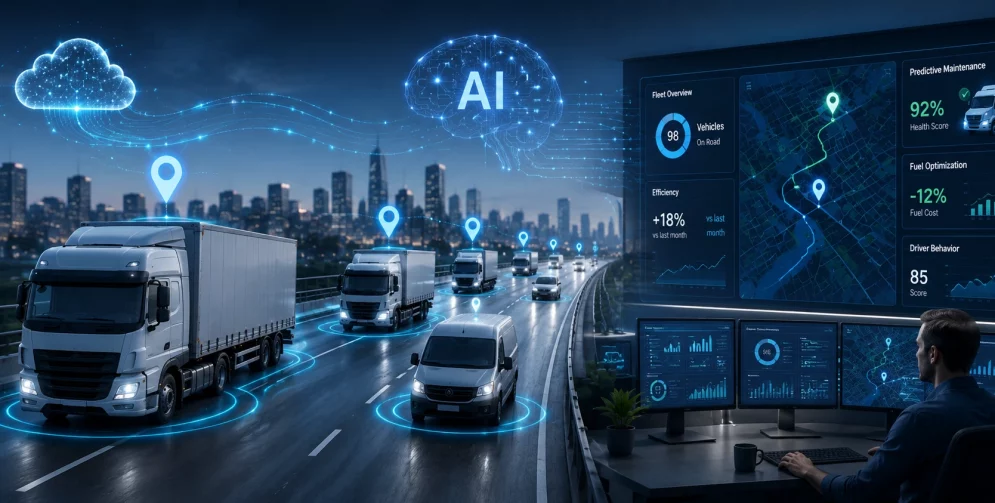
Fleet management is entering a new era.
For years, fleet managers have relied on GPS tracking, telematics, spreadsheets, scheduled maintenance, and manual reporting to keep vehicles moving. These technologies remain important, but the growing availability of artificial intelligence (AI) is changing what fleet management can achieve.
AI in fleet management is helping businesses move from reactive operations to proactive decision-making. Instead of simply knowing where a vehicle is, fleet managers can increasingly understand what is happening, identify potential problems, predict future events, and take action before those problems affect operations.
From predictive maintenance and intelligent route planning to driver monitoring, fuel optimization, and real-time fleet analytics, AI is becoming an important part of modern transportation operations.
Industry research in 2026 shows that AI adoption is already concentrated in areas such as route planning, dispatching, maintenance diagnostics, and preventative maintenance.
So, what does the future of fleet management look like—and how can businesses prepare?
What Is AI Fleet Management?
AI fleet management refers to the use of artificial intelligence, machine learning, telematics, IoT sensors, and operational data to monitor, analyze, predict, and optimize fleet activities.
Traditional fleet management often depends on predefined rules and manual intervention.
AI-powered fleet management goes a step further by identifying patterns in large volumes of data and using those insights to support faster and smarter decisions.
For example, an AI-enabled fleet management system can analyze:
- Vehicle location and movement
- Engine and diagnostic data
- Fuel consumption
- Driver behavior
- Vehicle utilization
- Maintenance history
- Traffic conditions
- Route performance
- Delivery schedules
- Idling patterns
- Safety events
When these data points are combined, fleet managers gain a more complete view of fleet performance.
The result is a shift from simply monitoring vehicles to optimizing the entire operation.
How AI Is Transforming Fleet Management
1. Predictive Maintenance Prevents Unexpected Breakdowns
Vehicle breakdowns can disrupt deliveries, increase repair costs, reduce customer satisfaction, and take vehicles out of service unexpectedly.
Traditional preventive maintenance generally follows fixed schedules based on mileage, time, or manufacturer recommendations.
AI introduces a more predictive approach.
By analyzing vehicle diagnostics, historical maintenance records, sensor data, mileage, operating conditions, and abnormal patterns, AI systems can help identify early signs of potential mechanical problems.
Instead of asking:
“When is this vehicle due for maintenance?”
fleet managers can begin asking:
“Is this vehicle showing signs that maintenance may be required soon?”
This enables businesses to schedule maintenance proactively and potentially reduce unplanned downtime.
Research published in 2026 highlights predictive maintenance as one of the core applications of AI and IoT in smart fleet management.
Benefits of AI-powered predictive maintenance include:
- Reduced unexpected breakdowns
- Better vehicle uptime
- More efficient maintenance scheduling
- Improved maintenance planning
- Longer asset life
- Better visibility into vehicle health
- Potentially lower repair costs
Predictive maintenance is therefore becoming a critical component of modern fleet management strategies.
2. AI-Powered Route Optimization Improves Efficiency
Route planning can become complicated when a fleet has multiple vehicles, delivery locations, traffic conditions, customer time windows, and changing road conditions.
A route that looks efficient in the morning may become inefficient several hours later.
AI-powered route optimization can analyze multiple variables simultaneously to help determine more efficient routes.
These may include:
- Traffic conditions
- Distance
- Delivery schedules
- Vehicle availability
- Road conditions
- Customer locations
- Driver schedules
- Fuel consumption
- Vehicle capacity
AI can also help adapt routes when conditions change.
For example, if congestion develops along a planned route, an intelligent system can identify an alternative route and provide the fleet manager or driver with updated recommendations.
The objective is not simply to find the shortest route.
It is to find a route that balances time, distance, fuel consumption, vehicle availability, and operational requirements.
Current fleet technology research identifies route optimization as one of the leading applications for AI in transportation operations.
3. Smarter Driver Monitoring and Road Safety
Driver behavior has a direct impact on fuel consumption, vehicle wear, accidents, insurance exposure, and overall fleet performance.
AI-powered driver monitoring can analyze driving patterns and identify potentially risky behaviors such as:
- Harsh braking
- Rapid acceleration
- Excessive speeding
- Sudden lane changes
- Distracted driving
- Aggressive driving
- Excessive idling
- Fatigue-related indicators
When combined with video telematics, AI can provide additional context around safety events.
Instead of reviewing hours of footage manually, fleet managers can receive alerts or prioritized events that require attention.
This allows safety teams to focus their efforts where they matter most.
AI therefore changes driver monitoring from a primarily reactive process into a more proactive safety strategy.
4. Real-Time Fleet Visibility
Knowing where every vehicle is remains one of the foundations of effective fleet management.
Modern telematics systems provide real-time visibility into vehicle locations, routes, movements, and operational events.
AI can take this information further by turning raw tracking data into actionable insights.
For example, AI can help identify:
- Unexpected route deviations
- Unusual stops
- Excessive idling
- Delayed deliveries
- Underutilized vehicles
- Repeated route inefficiencies
- Potential operational anomalies
The growing importance of connected data is also reflected in the 2026 fleet-management outlook, where real-time visibility and integrated telematics are increasingly viewed as essential tools for operational decision-making.
The future is therefore not simply about tracking vehicles.
It is about understanding what the tracking data means.
5. AI Can Help Reduce Fuel Consumption
Fuel is one of the largest operating expenses for many commercial fleets.
Small inefficiencies across dozens or hundreds of vehicles can quickly become significant costs.
AI can analyze fuel consumption alongside:
- Driving behavior
- Vehicle type
- Route characteristics
- Idling time
- Vehicle load
- Traffic conditions
- Maintenance data
- Driver performance
This makes it possible to identify patterns that may otherwise be difficult to detect.
For example, AI analytics may highlight vehicles that consistently consume more fuel than comparable vehicles or identify driving behaviors associated with unnecessary fuel consumption.
Fleet managers can then take targeted action through driver coaching, maintenance intervention, route changes, or vehicle utilization adjustments.
6. Better Fleet Utilization and Asset Management
A fleet can contain vehicles that are heavily utilized, underutilized, or operating inefficiently.
Without accurate data, fleet managers may struggle to determine whether they have the right number and type of vehicles for their operations.
AI can analyze utilization patterns to help answer questions such as:
- Which vehicles are being used most frequently?
- Which assets spend too much time idle?
- Which vehicles are assigned inefficiently?
- When is additional fleet capacity required?
- Which vehicles could be reassigned?
- Which assets may be candidates for replacement?
This can support better asset allocation and help businesses make more informed fleet investment decisions.
Connected fleet technology is increasingly being used to understand asset utilization and improve resource allocation.
7. AI Helps Fleet Managers Make Faster Decisions
One of the biggest advantages of AI is not necessarily automation.
It is decision support.
Fleet managers deal with thousands of operational data points every day. Manually analyzing all of that information is time-consuming and can make it difficult to identify the most important issues.
AI can process large datasets and surface patterns, anomalies, and recommendations much faster.
For example:
“Vehicle 24 has experienced three abnormal engine-temperature events in the last seven days.”
Or:
“Driver A has significantly higher harsh-braking events than the fleet average.”
Or:
“Route B has experienced repeated delays during the same delivery window.”
These insights give fleet managers a clearer starting point for action.
The future of fleet management is therefore likely to involve a combination of human expertise and AI-assisted decision-making rather than simply replacing human operators.
AI + Telematics: The Foundation of Intelligent Fleet Operations
AI works best when it has access to reliable data.
This is why telematics, GPS tracking, IoT sensors, video systems, and connected vehicle technologies are so important.
A modern AI fleet management ecosystem can combine data from:
Vehicles → Sensors → GPS → Telematics → Video → Cloud Platform → AI Analytics → Fleet Manager
Each layer contributes valuable information.
Telematics provides operational data.
IoT devices provide sensor information.
GPS provides location intelligence.
Video systems provide visual context.
AI analyzes these inputs and converts them into actionable insights.
This integration is one of the most important trends shaping the future of fleet management.
The Future: From Predictive to Proactive Fleet Management
The evolution of fleet management can be viewed in four stages.
Stage 1: Reactive Fleet Management
A vehicle breaks down.
The fleet manager responds.
Stage 2: Preventive Fleet Management
Maintenance is scheduled according to mileage or time.
Stage 3: Predictive Fleet Management
AI analyzes vehicle data to identify potential failures before they occur.
Stage 4: Proactive and Intelligent Fleet Management
AI continuously analyzes the fleet, identifies opportunities and risks, recommends actions, and increasingly automates routine operational decisions.
This progression represents a major shift.
Fleet management is moving from:
“What happened?”
to:
“What is happening?”
and eventually:
“What is likely to happen, and what should we do about it?”
What Fleet Managers Should Consider Before Adopting AI
AI can deliver significant operational value, but technology alone does not solve every fleet-management challenge.
Businesses should consider several factors before implementation.
1. Start With a Clear Business Problem
Do not adopt AI simply because it is a popular technology.
Identify the problem first.
For example:
- Too many vehicle breakdowns?
- High fuel costs?
- Poor route efficiency?
- Frequent safety incidents?
- Low vehicle utilization?
- Excessive manual reporting?
Then determine whether AI can address that specific challenge.
2. Build on Reliable Data
Poor-quality data can produce poor-quality insights.
Fleet businesses should ensure that their GPS, telematics, vehicle diagnostics, maintenance records, and other operational data are accurate and consistently collected.
3. Integrate Existing Systems
AI should ideally work alongside existing fleet management systems rather than creating another isolated data environment.
Integration with telematics, enterprise systems, maintenance platforms, dispatch software, and other operational tools can create a more complete view of fleet performance.
4. Keep People in the Loop
AI should support fleet managers, dispatchers, maintenance teams, and drivers—not simply overwhelm them with alerts.
The most effective systems turn complex data into clear, prioritized actions.
5. Measure Results
Before deploying AI, establish measurable KPIs.
Depending on the business, these may include:
- Fuel consumption
- Vehicle downtime
- Maintenance costs
- Accident frequency
- Driver safety scores
- On-time delivery
- Vehicle utilization
- Cost per kilometer
- Fleet productivity
Measuring these indicators makes it easier to determine whether an AI initiative is producing meaningful business value.
Why AI Will Become a Competitive Advantage in Fleet Management
The transportation industry operates under constant pressure to improve efficiency while controlling costs.
Fuel prices fluctuate.
Maintenance costs rise.
Customers expect faster deliveries.
Drivers need safer working conditions.
Businesses need greater visibility.
At the same time, fleets are generating more operational data than ever before.
AI provides a way to turn that data into decisions.
According to Verizon Connect’s 2026 fleet technology research, users of connected fleet technologies report improvements in productivity, asset utilization, and operational efficiency, while the industry is increasingly looking toward autonomous insights and agentic AI.
This suggests that the next competitive advantage may not come from simply having more vehicles.
It may come from operating existing vehicles more intelligently.
The Future of Fleet Management Is Intelligent, Connected, and Predictive
AI is transforming fleet management from a system focused primarily on tracking vehicles into an intelligent platform for managing entire operations.
Predictive maintenance can help prevent unexpected downtime.
AI route optimization can improve route efficiency.
Driver monitoring can strengthen safety programs.
Fuel analytics can identify operational waste.
Real-time telematics can provide greater visibility.
AI-powered analytics can help fleet managers make faster, data-driven decisions.
The technology will continue to evolve, but the fundamental objective remains the same:
Move people and goods more safely, efficiently, reliably, and intelligently.
For businesses looking to modernize their fleet operations, the future is not simply about adopting AI.
It is about connecting the right data, technology, and people to create a smarter fleet.
CAMTRACK combines fleet management and telematics with AI, IoT monitoring, video intelligence, predictive maintenance, fuel and energy management, and enterprise integration to help businesses gain real-time visibility and actionable operational insights.
Ready to build a smarter fleet? Explore how AI-powered fleet management can help your business improve efficiency, safety, and operational visibility.
Frequently Asked Questions About AI in Fleet Management
What is AI in fleet management?
AI in fleet management uses artificial intelligence and machine learning to analyze vehicle, driver, route, maintenance, and operational data. It helps fleet managers identify patterns, predict potential issues, optimize operations, and make faster decisions.
How does AI improve fleet management?
AI can improve fleet management through predictive maintenance, route optimization, driver behavior analysis, fuel management, real-time monitoring, asset utilization, and automated operational insights.
Can AI reduce fleet maintenance costs?
AI-powered predictive maintenance can help identify potential vehicle problems earlier, allowing businesses to plan maintenance before failures occur. The actual cost savings depend on fleet size, vehicle condition, data quality, maintenance practices, and implementation.
How does AI improve driver safety?
AI can analyze driving behavior and video events to identify potentially risky activities such as harsh braking, speeding, distraction, and aggressive driving. Fleet managers can use these insights for targeted coaching and safety interventions.
Is AI suitable for small fleets?
Yes. AI-powered fleet technology is increasingly available through cloud-based platforms and can be scaled according to fleet size. Small fleets can begin with focused use cases such as GPS tracking, driver safety, fuel monitoring, or predictive maintenance.
What is the difference between GPS tracking and AI fleet management?
GPS tracking primarily provides information about vehicle location and movement. AI fleet management can analyze GPS data alongside telematics, vehicle diagnostics, driver behavior, maintenance history, and other information to generate predictions and actionable insights.
What is the future of fleet management?
The future of fleet management is expected to become increasingly connected, predictive, automated, and data-driven. AI, telematics, IoT, video intelligence, predictive maintenance, and intelligent automation will play increasingly important roles in fleet operations.