

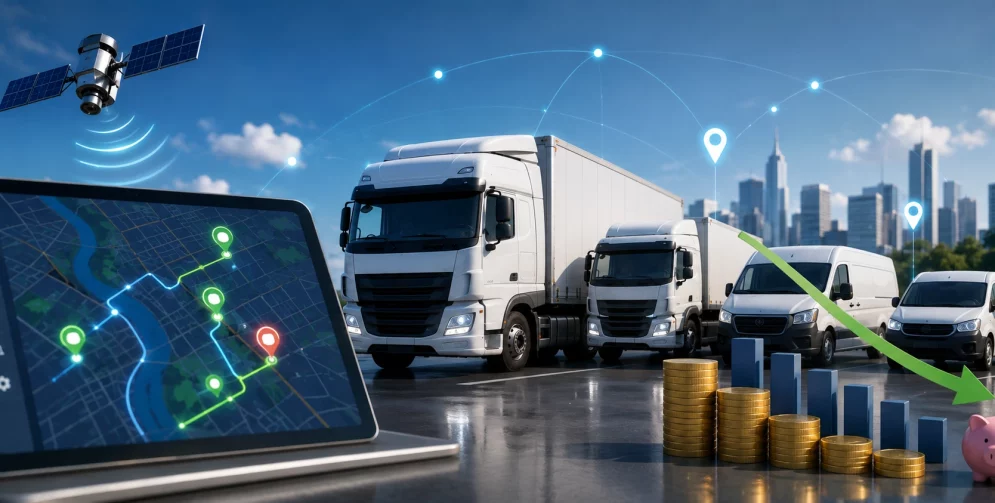
Managing a fleet is expensive. Fuel, maintenance, driver wages, vehicle downtime, insurance, unauthorized vehicle use, and inefficient routes can quickly reduce profit margins.
The challenge is that many of these costs are difficult to identify until they become significant.
GPS fleet tracking gives fleet managers real-time visibility into vehicles, routes, driver behavior, mileage, idle time, and vehicle activity. This data allows businesses to identify waste, improve efficiency, and make better operational decisions.
According to Verizon Connect’s 2026 Fleet Technology Trends Report, fleet professionals using technology report average decreases of 11%–19% in fuel, accident, labor, and maintenance expenses. The same report found that 80% of fleet professionals now rely on GPS fleet tracking technology.
Here are 10 ways GPS fleet tracking can help reduce fleet operational costs.
1. Reduce Fuel Consumption
Fuel is one of the largest recurring expenses for many fleets. Even small amounts of unnecessary fuel consumption can add up significantly across dozens or hundreds of vehicles.
A GPS fleet tracking system helps identify the behaviors and operational patterns responsible for fuel waste.
Fleet managers can monitor:
- Excessive idling
- Unnecessary mileage
- Aggressive acceleration and braking
- Excessive speeding
- Unauthorized vehicle usage
- Inefficient routes
- Repeated or unnecessary trips
For example, if a driver regularly leaves a vehicle running while stationary, fleet managers can identify the pattern and provide targeted coaching.
Industry research also supports the financial impact. Verizon Connect reports that fleets using GPS tracking have reported an average 16% reduction in fuel costs, while its 2024 fleet cost research found a 9% decrease in fuel costs reported by fleets using GPS tracking.
Bottom line: Better visibility into fuel-related behavior can turn hidden fuel waste into measurable savings.
2. Optimize Routes and Reduce Unnecessary Mileage
Every unnecessary kilometer costs money.
Longer routes mean more fuel consumption, more vehicle wear, more driver hours, and potentially more overtime.
GPS fleet tracking allows managers to analyze historical routes and identify opportunities to improve route planning. Real-time vehicle locations can also help dispatchers assign jobs more efficiently and avoid unnecessary backtracking.
Route optimization can help fleets:
- Reduce total mileage
- Avoid traffic congestion
- Eliminate unnecessary detours
- Improve vehicle utilization
- Complete more jobs per shift
- Reduce travel time
- Lower fuel consumption
Geotab identifies route optimization as one of the key ways fleet tracking can reduce operating costs, noting that inefficient routes increase fuel use and vehicle wear while reducing productivity.
For delivery, logistics, construction, and field-service businesses, optimizing even a few kilometers per vehicle per day can create substantial annual savings.
3. Lower Vehicle Maintenance Costs
Reactive maintenance is expensive.
When a vehicle breaks down unexpectedly, the business may face repair expenses, towing costs, missed deliveries, replacement vehicle costs, and lost working hours.
GPS fleet tracking can support a preventive maintenance strategy by recording mileage, engine hours, trip activity, and vehicle usage.
Instead of waiting for a vehicle to fail, fleet managers can schedule maintenance based on actual usage.
This can help businesses:
- Schedule servicing on time
- Identify heavily used vehicles
- Reduce unexpected breakdowns
- Extend vehicle lifespan
- Monitor maintenance intervals
- Reduce excessive wear and tear
The 2026 Fleet Technology Trends Report found that improving vehicle maintenance was one of the top goals achieved through GPS fleet tracking, with 43% of respondents identifying improved maintenance as an outcome.
Preventive maintenance costs money. Unplanned breakdowns can cost much more.
4. Improve Driver Productivity
Driver time is another major operational expense.
Without accurate fleet data, it can be difficult to determine how much time drivers spend driving, waiting, idling, taking unauthorized stops, or traveling inefficiently between jobs.
GPS fleet tracking provides visibility into vehicle activity and trip history.
Fleet managers can use this information to understand:
- Number of jobs completed
- Time spent traveling
- Time spent at customer locations
- Excessive stops
- Route deviations
- Idle time
- Vehicle utilization
This data can help managers identify bottlenecks and redistribute workloads.
The objective isn’t simply to make drivers work harder. It is to remove unnecessary delays so drivers can spend more of their working hours on productive tasks.
Verizon Connect’s 2026 research found that 44% of GPS fleet tracking users reported improved productivity.
5. Reduce Overtime and Labor Costs
Inefficient routing, unnecessary travel, and poor scheduling can cause drivers to spend more time on the road than necessary.
That can lead to overtime.
GPS tracking helps fleet managers understand how vehicles are being used throughout the day and where time is being lost.
For example, managers can identify:
- Routes that consistently take too long
- Jobs that cause scheduling bottlenecks
- Excessive travel between appointments
- Vehicles that are underutilized
- Drivers regularly approaching overtime
This information allows businesses to improve schedules and allocate vehicles more efficiently.
Reducing unnecessary driving time can therefore reduce both fuel expenses and labor-related costs.
6. Reduce Unauthorized Vehicle Use
Company vehicles can generate costs even when they aren’t being used for legitimate business activities.
Unauthorized trips may increase:
- Fuel consumption
- Mileage
- Maintenance requirements
- Vehicle depreciation
- Accident exposure
GPS vehicle tracking provides a digital record of where vehicles travel and when they are being used.
Geofencing can also help businesses establish virtual boundaries around offices, depots, customer locations, or other areas.
If a vehicle enters or leaves a predefined area unexpectedly, the system can generate an alert.
This makes unauthorized usage easier to identify and address.
Geotab lists taking action on unauthorized vehicle use as one of its key strategies for reducing fleet costs with GPS tracking.
7. Reduce Accident-Related Expenses
Driver behavior has a direct impact on fleet risk.
Speeding, harsh braking, aggressive acceleration, and other risky driving behaviors can increase the likelihood of accidents while also contributing to vehicle wear and fuel consumption.
GPS fleet tracking can identify these behaviors and provide fleet managers with actionable data.
Instead of relying entirely on complaints or assumptions, managers can use objective information to coach drivers.
A driver monitoring program can focus on:
- Speeding
- Harsh braking
- Rapid acceleration
- Excessive idling
- Unsafe driving patterns
- Repeated route deviations
The goal should be coaching rather than simply punishment.
Verizon Connect’s 2026 report found that 74% of organizations using video AI reported improved driver safety, while 48% reported reduced accident-related costs.
Fewer accidents can mean fewer repair bills, less downtime, lower administrative costs, and reduced business disruption.
8. Minimize Vehicle Downtime
A vehicle that isn’t working isn’t generating value.
Breakdowns can disrupt delivery schedules, delay service appointments, require emergency repairs, and force businesses to use replacement vehicles.
GPS fleet tracking helps managers identify vehicle activity and maintenance requirements before minor issues become major operational problems.
When integrated with telematics and maintenance data, fleet management software can provide alerts based on mileage, engine hours, vehicle condition, or other parameters.
This enables businesses to move from a reactive model:
Breakdown → Repair → Lost productivity
to a proactive model:
Monitor → Detect → Maintain → Keep vehicle operating
Reducing downtime improves vehicle availability and allows businesses to get more productive hours from the fleet they already own.
9. Improve Fleet Utilization
Buying more vehicles isn’t always the answer to increasing demand.
Sometimes the real problem is poor utilization.
A GPS fleet tracking system can show which vehicles are being used frequently and which ones spend significant amounts of time sitting idle.
Fleet managers can analyze:
- Vehicle utilization
- Daily mileage
- Operating hours
- Idle periods
- Job frequency
- Route coverage
- Vehicle availability
This information can help businesses determine whether they actually need additional vehicles or whether existing assets can be allocated more efficiently.
Better utilization can reduce unnecessary capital expenditure and improve the return on existing fleet investments.
In other words, GPS tracking isn’t only about knowing where your vehicles are. It can help you understand how effectively your vehicles are being used.
10. Reduce Administrative Costs and Improve Decision-Making
Fleet management involves a significant amount of administrative work.
Managers may need to track vehicle locations, mileage, driver activity, trip history, maintenance schedules, routes, and operational reports.
Without centralized fleet management software, much of this information may be collected manually.
GPS fleet tracking automates much of the data collection process.
Instead of relying on spreadsheets and driver reports alone, managers can access centralized information for:
- Trip reporting
- Mileage tracking
- Vehicle utilization
- Driver performance
- Route analysis
- Maintenance planning
- Geofence alerts
- Fleet performance reporting
The result is less manual administration and faster access to operational data.
More importantly, better data leads to better decisions.
How Much Can GPS Fleet Tracking Save?
The exact savings depend on fleet size, vehicle type, operating conditions, fuel costs, driver behavior, and how effectively the business acts on the data.
There is no universal savings percentage that applies to every fleet.
However, current industry research indicates that fleet technology can produce meaningful reductions across several cost categories.
Verizon Connect’s 2026 Fleet Technology Trends Report found that fleet professionals using technology reported average decreases of 11%–19% across fuel, accident, labor, and maintenance expenses. It also reported that nearly half of users across major fleet technologies achieved ROI in less than one year.
A simple way to estimate potential savings is:
Annual Fleet Savings = Current Annual Operating Costs × Expected Cost Reduction %
For example, a business spending ₹50 lakh annually on fleet-related operating expenses could potentially save:
- 5% = ₹2.5 lakh
- 10% = ₹5 lakh
- 15% = ₹7.5 lakh
These figures are illustrative, not guaranteed results. The actual ROI depends on the fleet and the specific GPS tracking solution.
Choosing the Right GPS Fleet Tracking System
Not every GPS tracking solution offers the same capabilities.
Before choosing a fleet tracking system, businesses should evaluate features such as:
Real-Time GPS Tracking
Provides visibility into vehicle locations and enables better dispatching and customer communication.
Route Optimization
Helps identify efficient routes and reduce unnecessary mileage.
Driver Behavior Monitoring
Tracks speeding, harsh braking, acceleration, and other driving events.
Geofencing
Creates virtual boundaries and provides alerts when vehicles enter or leave designated areas.
Maintenance Management
Supports preventive maintenance scheduling based on mileage, engine hours, or other vehicle data.
Fuel Monitoring
Helps identify excessive idling, inefficient driving, and potential fuel-related anomalies.
Reporting and Analytics
Transforms raw tracking data into useful operational insights.
Mobile Access
Allows managers to monitor fleet activity from smartphones and tablets.
The best system isn’t necessarily the one with the most features. It is the one that provides the data your business needs to make faster, more cost-effective decisions.
Conclusion
GPS fleet tracking is much more than a tool for locating vehicles.
When properly implemented, it becomes a fleet cost optimization system that helps businesses control fuel consumption, improve routes, reduce maintenance expenses, increase driver productivity, minimize downtime, and make better use of existing vehicles.
The biggest savings often come from small inefficiencies repeated across an entire fleet.
A few unnecessary kilometers per trip.
A few extra minutes of idling.
A missed maintenance interval.
An inefficient route.
An underutilized vehicle.
A recurring overtime pattern.
GPS tracking makes these inefficiencies visible.
And once they are visible, fleet managers can act on them.
For businesses looking to reduce operational costs while improving fleet efficiency, investing in GPS fleet tracking can be a practical step toward a more data-driven and profitable operation.
Frequently Asked Questions
1. How does GPS fleet tracking reduce operational costs?
GPS fleet tracking reduces operational costs by helping businesses control fuel consumption, optimize routes, improve driver productivity, reduce unauthorized vehicle use, support preventive maintenance, minimize downtime, and improve fleet utilization.
2. Can GPS tracking reduce fuel costs?
Yes. GPS tracking can help reduce fuel waste by identifying excessive idling, unnecessary mileage, inefficient routes, speeding, and other behaviors associated with higher fuel consumption.
3. Does GPS fleet tracking reduce maintenance costs?
It can. By monitoring mileage, vehicle usage, and maintenance schedules, fleet managers can move toward preventive maintenance and reduce the risk of unexpected breakdowns and excessive vehicle wear.
4. How does GPS tracking improve driver productivity?
GPS tracking provides visibility into routes, stops, travel times, idle periods, and job activity. Managers can use these insights to identify delays, improve scheduling, and allocate work more efficiently.
5. Is GPS fleet tracking worth the investment?
For many fleets, the answer can be yes, particularly when the system is actively used to address fuel waste, inefficient routing, maintenance issues, driver behavior, and vehicle utilization. ROI depends on fleet size, operating costs, technology pricing, and implementation.
6. What businesses benefit from GPS fleet tracking?
GPS fleet tracking can benefit logistics companies, transportation businesses, delivery services, construction companies, field-service organizations, rental fleets, school transportation providers, and other businesses operating multiple vehicles.